Neville Ann Kelly, D.Min., Ph.D.

Spiritual Direction, Integral Master Coaching

  • Spiritual Direction
  • Scholarship
    • Books
  • Teaching
    • Integral Theory Course
  • About

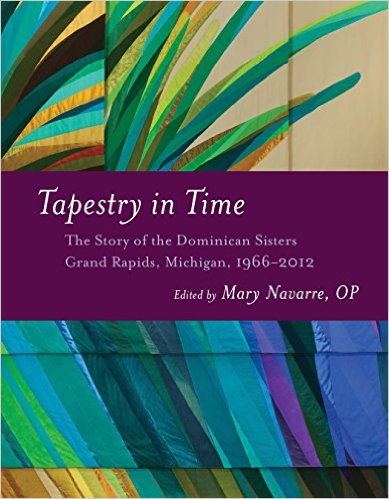
Tapestry in Time: The Story of the Dominican Sisters Grand Rapids, Michigan, 1966-2012. Edited by Mary Navarre, OP

March 4, 2016 By Neville Ann Kelly

Tapestry of Time, Navarre Cover
This compelling, collaborative history chronicles American Dominican sisters’ experience of significant changes following the Second Vatican Council’s call for ressourcement and aggiornamento. I am privileged to know many religious sisters, and this book invited me to more intimately participate in their congregations’ energetic, transformative, and sometimes disorienting reforms in the decades following the Council.


This is a story that needs to be told by those who lived it.


Joining other recent works celebrating the immense—but often overlooked—contributions and lived history of religious and monastic women, this book paints a vividly detailed portrait of how the sweeping reforms affected sisters’ individual lives and their communities. A sequel to Period Pieces: An Account of the Grand Rapids Dominicans 1853–1966 by archivist Mona Schwind (Grand Rapids: Sisters of St. Dominic, 1991), this work uses primary, experiential sources to discuss events within the changing theological contexts that prompted them.

Among these Dominicans, response to the Council inspired extraordinary transformations of liturgy, spirituality, education, community life, and ministry, each considered in four distinct parts. An introductory preamble situates the volume in the upheavals of the twentieth century and reflects on how the sisters’ varied responses to change resemble the community-stitched liturgical tapestry in the renovated Marywood Chapel. Like the textile, these interwoven strands represent the simultaneous unity of the congregation and the diversity of its members.

Where once a clear hierarchy, large group living, and a monastic-styled interior focus had structured daily life for centuries, Vatican II called these sisters beyond “the trials of childhood dependency and the adolescent turbulence of fierce independence” to “the give and take of adults living and dying in interdependence and mutuality” (p. 149). Turning to the originating sources of Scripture and the Dominican tradition, and guided by the signs of the times, these sisters boldly implemented reforms through a collegial creativity and dedicated commitment to “find Dominic’s tune for this nuclear space age” (p. 61).

Part 1: Challenge, Innovation, and Experimentation

Part 1 discusses landmark changes to personal and community prayer. Experimentation with different forms of prayer remained distinctly faithful to Saint Dominic’s ecclesial—yet innovative—tradition, allowing measured experimentation with new ideas and practices. A section on sisters’ first use of the vernacular English and Spanish in communal liturgy allows post-Vatican II readers the opportunity to discover this beauty as if for the first time.

Dominicans’ intense involvement in developing inclusive language for sacred texts and psalmody followed, along with other innovations all eyeing retrieval of order’s original, founding spirit. Discovery and development of charismatic gifts, liturgical dance, expanded annual retreats, architectural renovations, and a particular emphasis on sisters’ ministry of preaching led to a number of pioneering educational conferences and institutes. Uniformity of observance gave way to collaboration, dialogue, creativity, diversity, and social consciousness, yielding a renewed focus on the Dominican charism of study.

Part II: Shifting Identity and Mission

Covered in Part II, intellectual and spiritual formation involved extensive revision of sisters’ approach to theology and its concrete application in the world. Inspired by Cardinal Suenen’s Nun in the World: Religious and the Apostolate (London: Burns & Oates,1963), insightful leaders like Sister Aquinas Weber (prioress 1966-1972) guided the congregation through the challenging implementation of Perfectae Caritatis. The pre-Vatican II emphasis on external symbols such as uniform clothing, gave way to a deepened understanding of sisters’ essential identity and mission, and expanded their potential in professional theology and secular arts and sciences.

Parts III & IV: Interpretation, Conflict, and New Horizons

Not surprisingly, Part III on the common life and Part IV on ministry both reflect the profound conceptual shifts underlying post-Conciliar reform. Issues of conflict over the many changes reflected sisters’ varied interpretations, and disagreements arose at times. For example, modification of the traditional Dominican habit, essentially unchanged since its medieval design, required prolonged discussion, debate, and experimentation. Living in non-convent styled houses without an appointed superior offered another difficulty that required finding new ways of intentional community life, “not dependent on common walls, but common hearts” (p. 145).

As Vatican II opened the windows to the world, sisters opened their daily lives to others, religious or laity, including those who had left their community and lay associates. Formation of a collaborative novitiate and numerous coalitions assisted sisters in an expanded vision for Aquinas College while supporting establishment of missions in New Mexico, and Chimpote, Peru while serving in varied ministries of peacemaking and justice worldwide.

Remaining Faithful

Narrator Mary Navarre concludes this compelling, well edited and exquisitely organized compilation of theologically grounded memoirs by reflecting on why “this is a story that needs to be told by those who lived it” (p. 282). This approach succeeds in opening an illuminating portal into both the profound and mundane transformations of post-Conciliar Dominican life. While some readers may wish for inclusion of critique of the Roman Catholic hierarchy’s recent investigation of the American Leadership Conference of Women Religious, Navarre insists that while “investigations and assessments flare up, come and go” (p. 284), sisters are more imminently concerned with living authentic lives of deep prayer, study, common life, and socially conscious service, while viewing “always in the distance—the shadow of the cross” (p. 286).

TAPESTRY IN TIME: The Story of the Dominican Sisters, Grand Rapids, Michigan, 1966-2012, edited by Mary Navarre. ISBN 978-0-8028-7255-5. Eerdmans, 2015, pp. 336.  $20.00 pb.

Reviewed by Neville Ann Kelly. Excerpts from this review were originally published in Catholic Books Review.

Filed Under: Book Review Tagged With: Catholic, Nuns & Sisters, Spirituality, Tradition, Vatican II

Revising Benedictine History: A Caution, Call, and Possibility

March 19, 2015 By Neville Ann Kelly

San Benedetto Altarpiece, Lorenzo Monaco (1407-1409)

Having spent a good many years as a member of a new monastic community, I had anchored my early experience in a sometimes misguided hope. I often—though unconsciously—presumed that such an intentional life, guided by a Rule, would transform its practitioners into paragons of virtuous charity and spiritual perfection through a kind of spiritual osmosis.

Wisdom proved otherwise with the course of time, and I began to understand that commitment to a particular way of life could—indeed—be immensely transformative and life giving. But the “osmosis” I presumed was not a universal given, nor did spiritual growth always look the same.

Inspiration in the Annals

I struggled to understand the disillusioning fragments of human frailty and failure as I discerned stepping away from my own community. Quite unexpectedly, I found a paradoxical source of inspiration in the annals of monastic history. The perpetual alternations of wisdom and folly I found there was a mirror of humanity, extraordinarily hope-filled at times and abysmally desperate at others.

Providentially, during this critical time of growth and discernment I became a student of Sister Ann Kessler, a Benedictine nun-historian who had made telling the story of monasticism her life’s work. Returning from numerous research forays to monastery libraries and archives around the world, she continued to share her extensive knowledge for over five decades at Mount Marty College as Professor of History, social activist, politician, and now retired monastic historian.

Benedictine Roots & History

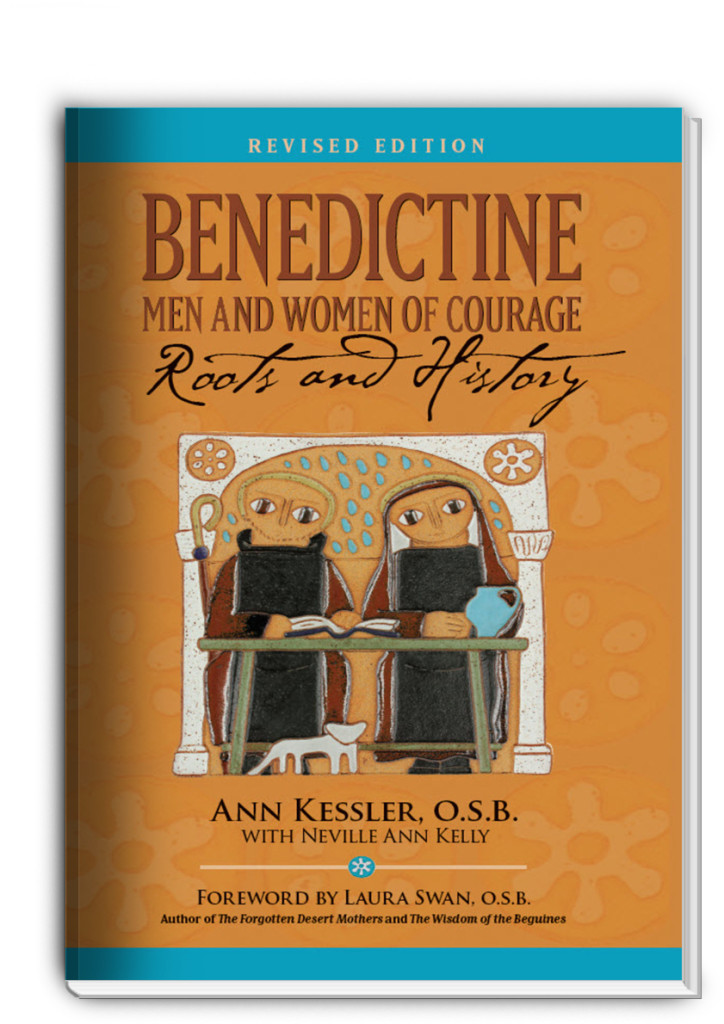
During her active career, a number of Sister Ann’s students, monastic formation directors, and other academics persuaded her to collect her varied manuscripts, lecture notes, and illustrative handouts that accompanied her courses, lectures, and seminars into a book. Published by Sacred Heart Monastery in 1996, Benedictine Men and Women of Courage: Roots and History came to life as a detailed description of the development of the Order of Saint Benedict. The book presented an inclusive and comprehensive history finally available for its eager readers, uniquely interweaving the histories of both monks and nuns.

Called “monumental” by monastic historian Esther De Waal (2001, p. 162), the publication had long sold out and was no longer in print despite its demand. As a student, I meticulously photocopied the library’s volume for my coursework, and later digitalized—with the help of a near-heroic work-study study student of mine—its 540-plus pages. With Sister Ann’s permission, I placed the book for free download on the Web, not realizing I was destined to spend nearly a full year—over a decade later—extensively editing and revising the book into its new, more readable form.

The time had come for this important work to not only resurface, but to be made much more widely available. As I have written in the books’ new Preface, the book Benedictine Men and Women of Courage: Roots and History, Revised Edition (2014)

invites Benedictines and non-monastics to comprehend our present through the lens of both favorable and tragic past events, personalities, and contexts that continue to ground our present and shape our future. Sister Ann’s tireless zeal for monastic history and its implications for life within both the monastery and the world make this book a timely outpouring of love, caution, and possibility.

As Laura Swan, OSB writes in her Foreword to the Revised Edition,

People are looking anew at the possibilities of Benedictine spirituality and the monastic way of life. Intentional communities based on the Gospel, a Rule of Life, and with a commitment to works of justice continue to emerge. These new communities and traditional monastic communities are connecting. Families are basing family life and the raising of children on the Rule of Benedict. Increasing numbers of people are becoming oblates, bringing the wisdom of Benedict to their communities.

Beyond the urgency of this drive for connection, new contexts and questions arise. Monastic life continues an archetypical call to a deeper wisdom (Panikkar, 1982).

Deeper Roots, Emerging Wisdom

The appeal of the monastic values of grounded place, welcoming openness, and contemplative action transcends religious affiliation to reveal an intrinsic longing to lay down roots in the rich spiritual soil of an ancient lineage.

A life-encompassing Rule exerts its power in unexpected ways and places, without regard to its varied interpretations. The divergent response to “race along the way” (RB Prologue 49) makes the fifteen centuries of Benedictine change, decline, restoration, and renewal discussed in this book worthy of its new edition.

During years of an uncertain caution, I was called to consider new possibilities. Knowledge of monastic history had opened me to the complex unpredictability of the spiritual life. No longer an “osmotic” certainty, transformation takes shape differently across centuries, cultures, and individuals. It occurs in the presence of crisis and disillusionment, of banishment, censure, and annihilation as well as in the stable quietude of daily lives of prayer and work.

To order Benedictine Men and Women of Courage: Roots and History, Revised Edition and for more information, please visit the book website.


__________________________________

References

De Waal, E. (1984/2001). Seeking God: The Way of St. Benedict. Collegeville: Liturgical Press.

Kessler, A. (1996). Benedictine Men and Women of Courage: Roots and History (1st edition). Yankton, S.D.: Sacred Heart Monastery.

Kessler, A., & Kelly, N.A. (2014). Benedictine Men and Women of Courage: Roots and History, Revised Edition. Seattle: Lean Scholar Press.

Panikkar, R. and North American Board for East-West Dialog. (1982). Blessed Simplicity: The Monk as Universal Archetype. New York: Seabury Press.

Filed Under: Uncategorized Tagged With: Catholic, Monasticism, Spirituality, Tradition

Why Christianity Must See Itself from Its Periphery

February 21, 2014 By Neville Ann Kelly

Pope Francis’ recent urge to “move around, to see reality from various viewpoints” (2014, p. 4) offers Christianity a transformative invitation to see itself anew, apart from the “centralism and ideological approaches” so often coloring its history.

Image credit: Veer.com

I was asked to offer an interpretation of what this might mean for us, our communities, and our institutions.

 In response, I immediately recalled the quote attributed to Albert Einstein (1879-1955):


No problem can be solved from the same level of consciousness that created it.”


This wisely suggests the rather common-sense idea that growth requires an upleveling—a dramatic shift—in the way we approach any situation.

Looking In, Looking Out

Before such innovative action can actually take shape, the matter must be seen from an entirely new angle.

This is much like the gradual horizon, unfolding before 15th century sailing vessels, helped disclose a spherical earth. More contemporarily, it is the transformational sight of the earth from space that has helped us radically recognize our planetary responsibility.

As Pope Francis recently noted, these “great changes in history were realized when reality was seen not from the center but rather from the periphery” (2014, p. 3). Expanding our knowledge of what Bernard Lonergan called the “incomplete and approximate portrayals of an enormously complex reality” (1972, p. 219) always requires a new viewpoint, a new perspective.

A Turbulent Margin

This necessarily makes Francis’ “move away from the central position of calmness and peacefulness” (2014, p. 3) our perspective-changing beginning.

From that place of the turbulent margin, we will proceed. Drawing from another of our senses next time, we will begin to look in on ourselves.

References

Lonergan, B. J. F. (1972). Method in theology. Minneapolis: Seabury.

Spardaro, A. (2014). Wake up the world: Conversation with Pope Francis about the religious life. La Civilta Cattolica (I), 3-17.

Disclosure of Material Connection: The link to Lonergan’s book is an affiliate link. This means if you purchase this book by clicking on the link , you contribute to the maintenance of this site. Thank you!

Filed Under: Posts Tagged With: Catholic, Integral, Theology

Pope Francis on Embracing Multiple Perspectives

January 17, 2014 By Neville Ann Kelly

The popularity of Roman Catholic Pope Francis has soared as his “off the cuff,” conversational style of speaking continues to make headlines worldwide. In keeping with this trend, the Italian Jesuit journal La Civilta Cattolica recently published a transcript of the Pope meeting with a group of superiors general of religious orders last November, again sending waves through popular media.

Image Credit: c2010ralanscott, fotosearch


Less emphasized in the press is a significant comment, quoted below, indicating the Pope’s desire to urge a multiperspectival understanding of the world’s complexity. Rather than simply suggesting the important emphasis of social justice toward the marginalized alone, the comment also discloses how the direction of one’s view can change not only perception, but empowers clarity and full understanding of realities.

I am convinced of one thing: the great changes in history were realized when reality was seen not from the center but rather from the periphery. It is a hermeneutical question: reality is understood only if it is looked at from the periphery, and not when our viewpoint is equidistant from everything.

Truly to understand reality we need to move away from the central position of calmness and peacefulness and direct ourselves to the peripheral areas. Being at the periphery helps to see and to understand better, to analyze reality more correctly, to shun centralism and ideological approaches.

It is not a good strategy to be at the center of a sphere. To understand we ought to move around, to see reality from various viewpoints.”

~ Pope Francis

The quote is found in Wake Up the World: Conversation with Pope Francis about the Religious Life , pp. 3-4.

PopeFranWakeUpMag

Reference

Spardaro, A. (2014). Wake up the world: Conversation with Pope Francis about the religious life. La Civilta Cattolica(I), 3-17.

Filed Under: Articles, Quotes Tagged With: Catholic, Integral, Theology

  • Monasticism
  • Spirituality
  • Theology

Integral Coach™ and Integral Coaching® are trademarks in Canada owned by Integral Coaching Canada Inc. and licensed to Neville Ann Kelly.
Copyright © 2026 · Neville Ann Kelly, D.Min., Ph.D.